Steinbach Deputy Mayor Michael Zwaagstra Challenges Quebec Town’s ‘Rights of Trees’ Resolution
A recent decision by a Quebec municipal council to grant legal rights to trees has sparked regional discussion over the limits of local governance and symbolic declarations. Writing in a column published in The Carillon, Steinbach Deputy Mayor and local teacher Michael Zwaagstra responded to the resolution passed by the town of Terrasse-Vaudreuil, examining the practical realities of municipal tree protection and arguing against assigning human legal rights to the natural environment.
Earlier this year, the town council of Terrasse-Vaudreuil—a small municipality situated west of Montreal—voted unanimously to officially recognize trees as living beings endowed with rights of their own. By taking this official step, Terrasse-Vaudreuil became the very first municipality in Canada to formally endorse the Universal Declaration of the Rights of Trees. The unanimous municipal vote represents an unusual legal move in Canadian local government, raising questions regarding property rights, environmental regulation, and the appropriate scope of municipal declarations.
Examining the Universal Declaration of the Rights of Trees
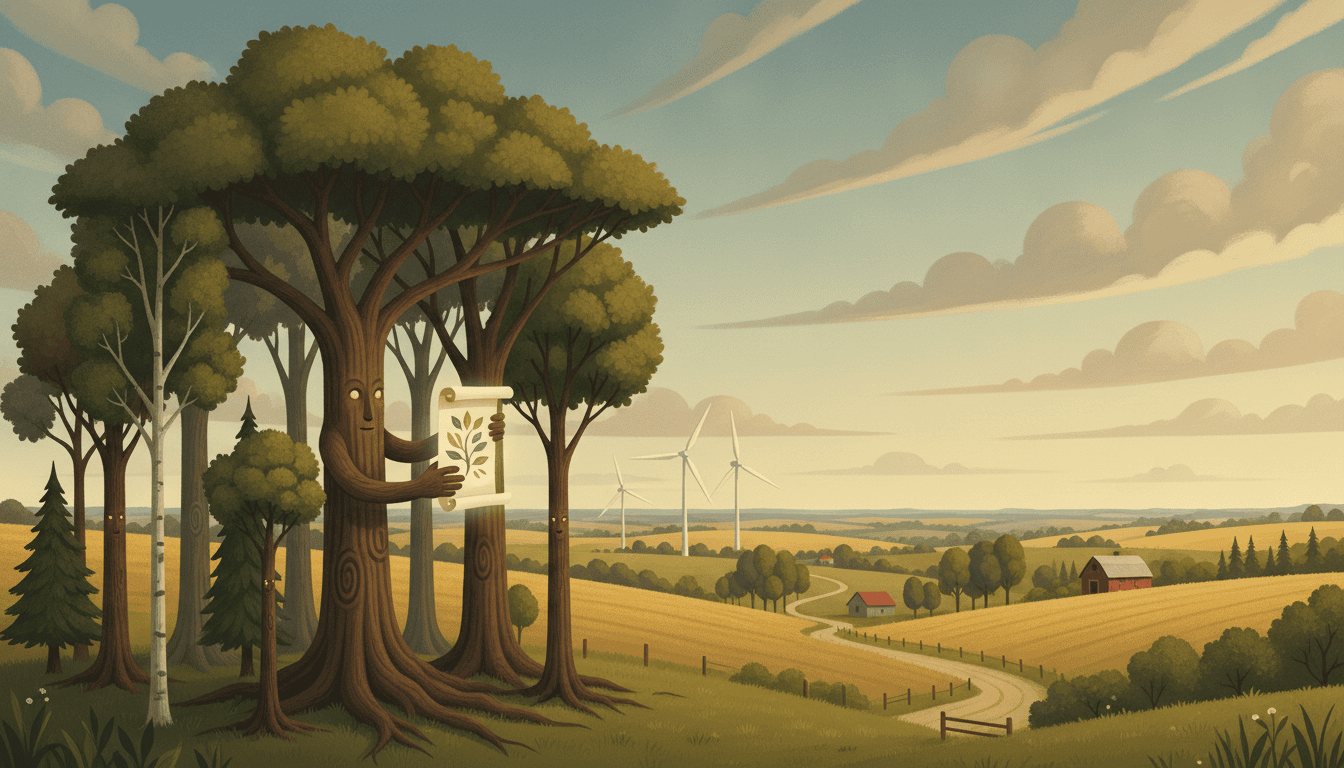
In his commentary, Zwaagstra drew a direct contrast between artistic appreciation for nature and modern legal classifications. More than a century ago, poet Joyce Kilmer wrote his famous work, Trees. Kilmer’s poem opens with the classic line, ‘I think that I shall never see a poem lovely as a tree,’ and proceeds to ascribe human-like characteristics to the natural world. In Kilmer’s verses, a tree ‘looks at God all day’ and ‘lifts her leafy arms to pray.’ While Kilmer was clearly impressed by the beauty and majesty of trees, Zwaagstra noted that even the historic poet would likely be flabbergasted by a municipal government extending actual legal rights to plant life.
The specific text of the Universal Declaration of the Rights of Trees outlines broad legal claims regarding environmental protection and land usage. Article 1 of the declaration explicitly states that, ‘All trees have the legal right to exist, flourish and evolve.’ Under a strict interpretation of this article, if an individual or business seeks to construct a new home or building and a tree happens to stand in the middle of the property, the owner could not cut it down without violating the tree’s legal right to exist.
Article 2 of the declaration expands this legal framing even further, asserting: ‘Every tree has the right to recognition everywhere as having legal rights. No distinction shall be made on the basis of political, jurisdictional or international status of the country or territory to which a forest belongs, whether it be independent, trust, non-self-governing or under any other limitation of sovereignty.’ Under this provision, location and property ownership do not alter a tree’s legal standing, asserting that a tree has as much right to exist as a human being.
Regarding enforcement, Article 3 of the declaration mandates that any alleged violations of the rights of trees shall be prosecuted before the ‘International Court for the Rights of Forest Ecosystems.’ Zwaagstra characterized these sweeping legal declarations as unadulterated nonsense, emphasizing that while people admire trees and recognize their obvious benefit to the ecosystem, common sense indicates that it is absurd to give trees the same legal rights as human beings.
Symbolic Declarations Versus Practical Municipal Bylaws
Following the passage of the resolution, the mayor of Terrasse-Vaudreuil discussed the decision during an interview with CBC. In the interview, the mayor explained that passing the resolution meant the town would review its existing bylaws to ensure trees within its jurisdiction are protected. However, the mayor also acknowledged a key operational fact: the resolution will not impact future development because Terrasse-Vaudreuil has no vacant land available for new development.
Analyzing the mayor’s comments, Zwaagstra noted that reading between the lines makes it clear the resolution is largely symbolic. Because the town already maintains plenty of tree protection regulations and lacks open land for new construction, the endorsement changes very little on the ground. Nonetheless, Zwaagstra warned that politicians act foolishly when they pass municipal declarations containing flowery legal guarantees that cannot possibly be enforced in reality.
Rather than relying on sweeping legal declarations that ascribe human rights to nature, Zwaagstra argued that local governments aiming to preserve their forest canopy should enact practical, enforceable bylaws. Sensible municipal regulations should clearly define where trees ought to be planted, how they should be maintained and cared for, and under what specific circumstances it is acceptable for property owners to cut them down. According to Zwaagstra, municipal leaders can easily craft sensible environmental regulations without resorting to exaggerated legal frameworks.
Recalling the conclusion of Kilmer’s poem—which observed that ‘Poems are made by fools like me, but only God can make a tree’—Zwaagstra concluded that while the original poem was not foolish, officially declaring that trees have human rights certainly is. Zwaagstra, who serves as a local teacher and deputy mayor of Steinbach, can be reached at mzwaagstra@shaw.ca.
Reporting based on commentary published in The Carillon.