Stuartburn Session Details Proposed Drainage Solutions for Sundown Ridge and Caliento Bog
Stuartburn Session Details — An almost full house gathered at the Vita Hall last Wednesday night as Rural Municipality of Stuartburn residents and municipal politicians came together for an extensive information session detailing proposed municipal drainage solutions. The meeting focused on comprehensive engineering proposals designed to protect local homes and agricultural land from persistent overland flooding. ‘Since this council took office in 2022, water and drainage have been amongst the biggest concerns and challenges facing the RM,’ stated Stuartburn Reeve Michelle Gawronsky. ‘Rather than looking at isolated trouble spots, we wanted to understand the whole system,’ she explained to the assembled crowd.
Engineering Proposals and Provincial Flood Studies
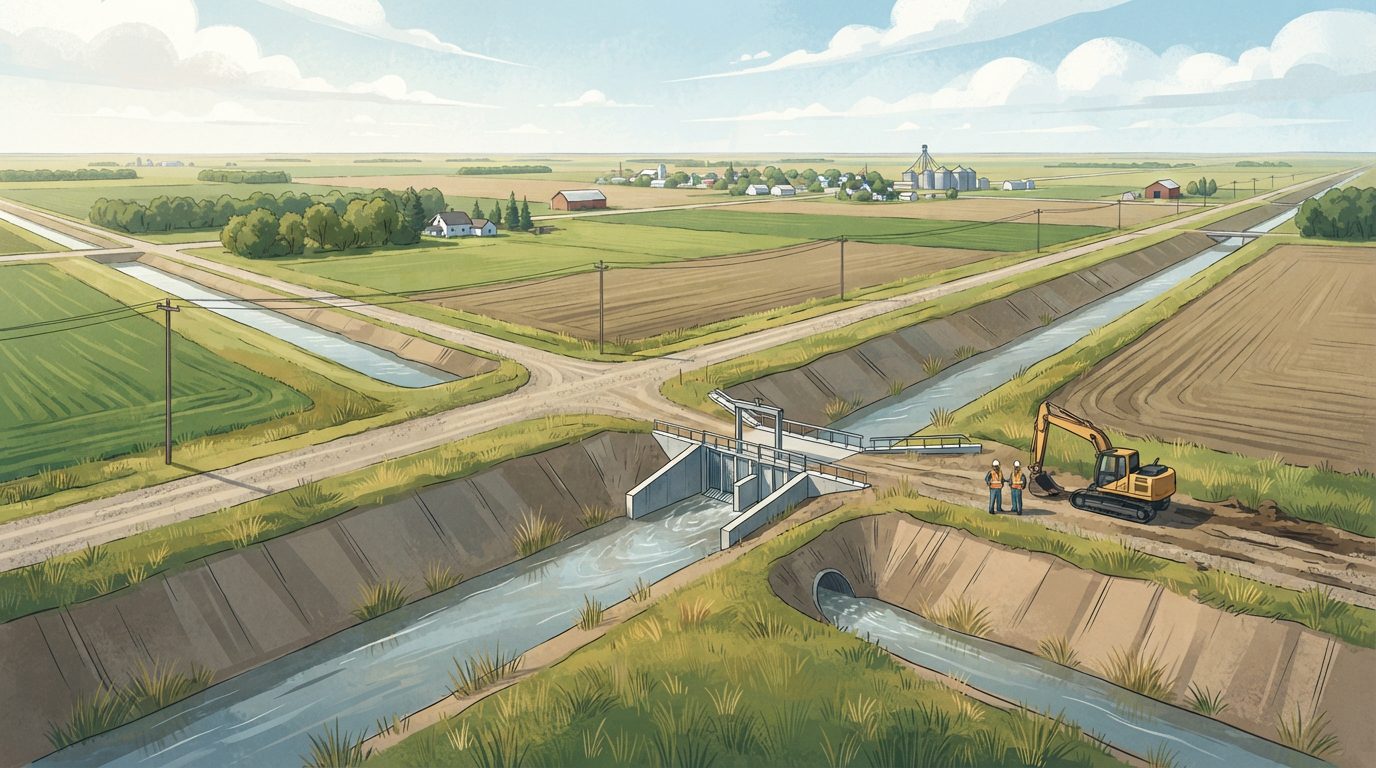
Engineers from Strategic Solutions Engineering (SSE) presented findings from a comprehensive drainage survey conducted earlier this year, recommending designated water retention sites at Sundown Ridge and, subject to available funding, the Caliento Bog. SSE CEO and head engineer Hank Venema, alongside team member and engineer Andrew Murray, outlined the hydrological history and technical recommendations for the region. The area surrounding the Sundown Ridge project originally drained west around the north side of Sundown. Later, Manitoba Transportation and Infrastructure constructed a drain to direct water flow south through the old PR 201 toward Sundown Bog along Road 54E, effectively preventing most flow from moving west, with the exception of local overland flow. To address remaining vulnerabilities, SSE recommended constructing a berm on the northeast side of Sundown Ridge to regulate water movement through a controlled outlet.
The proposed retention projects align with broader provincial research. A 2017 provincial study examining the Roseau River Watershed—which encompasses the majority of the RM of Stuartburn—identified five key locations in southeastern Manitoba as high-priority sites for water retention. Among these priority locations were the Sundown Ridge project and the Gardenton Floodway, which is currently in development. Provincial findings indicated that a retention site at Sundown Ridge could achieve significant flood reduction, cutting peak water flows by 83 percent during 10-year flood events and by 67 percent during 100-year flood events, thereby substantially lessening downstream flood impacts. Furthermore, the 2017 study concluded that combining the storage capacity of the Sundown Ridge retention site with a proposed retention site at Horseshoe Lake in the neighboring RM of Piney would be sufficient to hold all water inflows during a 100-year flood event.
In addition to the Sundown Ridge plans, SSE submitted a detailed study to the RM of Stuartburn in July 2024 concerning the Caliento Bog water retention site. That study highlighted the vital role of the Z Dyke, situated at the northwest side of the bog. The Z Dyke could redirect water from the Vita Drain and the Rat River into the Caliento Bog, where water would be stored and released gradually. This controlled mechanism is designed to safeguard homes and farmland while simultaneously managing both flood conditions and dry periods of drought.
Resident Perspectives and Local Debate
Despite the technical presentations, reactions from local property owners during the information session were mixed, sparking detailed exchanges between residents and the engineering team. Dale Dooley, whose family owns land northeast of the town of Sundown and experiences recurring overland flooding from Horseshoe Lake, expressed strong opposition to the Sundown Ridge proposal. Dooley, who has opposed the project since first learning of it, voiced concerns that the retention site would exacerbate flooding in Sundown rather than protect local homes. ‘Unless you’re building a complete lagoon that’s four-sided, that’s built out of clay or a liner, this will not work,’ Dooley argued, calling for SSE to conduct additional soil samples and further studies. He emphasized that municipal efforts should focus primarily on maintaining existing municipal drains rather than constructing new retention projects. In response, Venema explained that drainage networks and retention ponds must be developed and maintained together for systemic water management to function effectively.
Sundown resident Bill Dell, who is currently suing the RM of Stuartburn over flood damage to his property, echoed Dooley’s skepticism, describing the Sundown Ridge project as a mistake. Dell also raised questions regarding whether Venema held a personal financial stake in SSE’s recommendations related to commercial cattail harvesting. Venema acknowledged owning shares in a company that harvests and sells cattails for commercial applications, including biomass fuel and as a substitute for peat moss. However, Venema clarified that his company has no interest in conducting harvesting operations within the RM of Stuartburn.
Other attendees offered supportive perspectives while sharing their personal struggles with high water levels. Paul Stadnyk, an 81-year-old resident living on Road 38 East approximately nine miles north of Vita, explained that he previously had to construct a dike around his property because he lives adjacent to a swamp. Despite recognizing that the proposed retention site would not directly protect his own land, Stadnyk voiced support for the initiative. ‘It’ll help the people out there. And I hope maybe someday, eventually I might get some help here, like when they talk about (cattail harvesting),’ Stadnyk remarked, noting that dense cattail growth near his property blocks water flow, forcing excess water onto flat agricultural land.
Meanwhile, 80-year-old farmer Tom Shewera, whose property borders the eastern side of the Caliento Bog, shared that portions of his land have experienced flooding for over a century. Shewera noted that he pays close to $200,000 per quarter in property taxes and commented that ‘the land is not good for half the price.’ He inquired whether his land would hold value if sold immediately or if he should wait until the retention project is constructed. Engineer Andrew Murray advised Shewera that the land would likely appreciate in value after the retention project is built due to the added protection against flooding. In response, Shewera jokingly asked Murray, ‘Do you want to buy some land?’
Economic Incentives and Potential Revenue Credits
Beyond flood protection, municipal officials and engineers outlined potential economic incentives associated with the Sundown Ridge and Caliento Bog projects. The RM could generate revenue by selling retained water and harvested cattails, alongside earning potential phosphorus and water supply credits. Venema estimated that retained water could be sold for approximately $2 per cubic metre—matching the rate charged by the Pembina Valley Water Co-op—while harvested cattails could fetch around $100 per ton. According to Venema and Reeve Gawronsky, funds generated from these commercial activities could help offset the costs of constructing the Sundown Ridge and Caliento projects, as well as funding future drainage infrastructure throughout the municipality. Reeve Gawronsky did not state whether private landowners would receive a portion of profits generated from cattail harvesting on their individual properties.
Venema concluded by pointing out that effective flood mitigation enhances the municipality’s economic prospects by creating a secure environment for commercial investment. By mitigating flood risks, Stuartburn becomes more appealing to prospective industries seeking stable locations for capital investments. ‘But the bottom line is, when you stack up all these benefits, it’s a good project. It’s a good project. There’s reasons to do this project,’ Venema told the audience.
Reporting based on original coverage from The Carillon. Stay tuned for further updates on Stuartburn Session Details.